E-mail:
Password:
not a member?
My Cart
|
My Account
|
Info Request
help
Product Finder
Entire Web
(800)23-FUTEK or (949)465-0900
Contact Us
Monday, May 12 - 0:16 PST
Products
Custom Sensors
Load Cell
Torque Sensor
Force Sensor
Pressure Sensor
Multi Axis
Instruments
Accessories
Live Support
Need live help from our web and sales team?
Click here
.
Reps & Resellers
United States
International
Product Guide
A compact reference to Futek Load Cells, Force, Torque, and Pressure Sensors, Instruments, and Accessories.
Online Calculators
Bolt Torque
Shunt Calculator
Span Adjustment
Unit Conversion
Zero Balance
Calibration Record
Please enter your
sensor ID:
Support
RMA Form
Credit Application
Terms & Conditions
Smart Tools
Tips & Recommendations
FAQ
Calibration FAQ
Who to Contact
FUTEK Manuals
Wiring Codes
Sensor Products FAQ
Downloads
Troubleshooting Guide
Online Support
Smart Tools
Bolt Torque Calculator
American
Metric
Bolt Data
Size:
Select..
Custom..
#0
#1
#2
#3
#4
#5
#6
#8
#10
1/4"
5/16"
3/8"
7/16"
1/2"
5/8"
3/4"
7/8"
1"
1 1/4"
1 1/2"
1 3/4"
2"
2 1/4"
2 1/2"
2 3/4"
Coarse
Fine
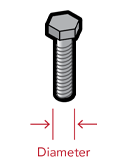
Major Diameter:
in
Thread per Inch:
Material:
Select..
Custom..
Steel Average
Steel Grade 1
Steel Grade 2 (1/4 - 3/4)
Steel Grade 2 (Over 3/4 - 1-1/2)
Steel Grade 4
Steel Grade 5 (1/4 - 1)
Steel Grade 5 (Over 1 - 1-1/2)
Steel Grade 7
Steel Grade 8
Stainless Average
Proof Strength:
psi
Bridge Resistance
The bridge resistance of the wheatstone bridge within your sensor.
To find your resistance:
Use a multimeter to determine the resistance across the +Signal and -Signal wires. This value is your bridge resistance. Typical Futek sensors have a bridge resistance of 350, 700 or 1000 Ohms.
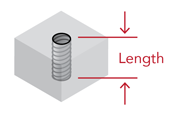
Length
Length of engagement. The distance that the two THREADED regions engage. The typical minimum recommended value is 1.5 times the major bolt diameter.
Mating Thread Data
Length:
in
help..
Material:
Select..
Custom..
A36 Structural Steel
4140 Steel
4340 Steel
410 Stainless
17-4 PH Stainless
17-7 PH Stainless
2024-T6 Aluminum
2024-T4 Aluminum
6061-T6 Aluminum
Yield Strength:
psi
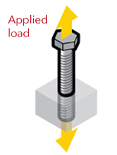
Applied Load
Load applied to either the bolt or tapped unit. Use for axial load applications.
For standard bolt torques use 0
.
K Factor
K Factor is a torque coefficient between bolt and receptacle. It is a function of the materials' frictional characteristics, which are based on surface finish, coatings and so on.
Various K Factors
Typical Steel Bolt
0.20
Zinc-Plated
0.20
Lubricated
0.18
Cadmium-Plated
0.16
Miscellaneous Data
Applied Load:
tensile
lb
help..
K Factor:
advanced users only
help..
My FUTEK
Account Overview
Create Account
Edit Account Info
Forgot Password?
Web Feature
Request Info
Events
Oct. 22-24, 2008
Did You Know
Want to know your order history?
click here
Newsletter
want to stay informed?
Sign up for our Monthly Newsletter!
US Manufacturer
Browser
|
Privacy & Security
|
Terms of Use
|
Site Map
|
Contact Us
Load Cell
|
Bending Beam Load Cell
|
Canister Load Cell
|
Column Load Cell
|
Compression Load Cell
|
Custom Load Cell
|
Donut Load Cell
|
High Capacity Load Cell
|
Low Capacity Load Cell
|
Miniature Load Cell
|
Pancake Load Cell
|
Precision Load Cell
|
Pressure Sensor
|
Reaction Torque Sensor
|
Rotary Torque Sensor
|
S Beam Load Cell
©1998-2008 FUTEK Advanced Sensor Technology, Inc. All rights reserved.