Bringing Precision and Consistency to Surface Finishing with Robots
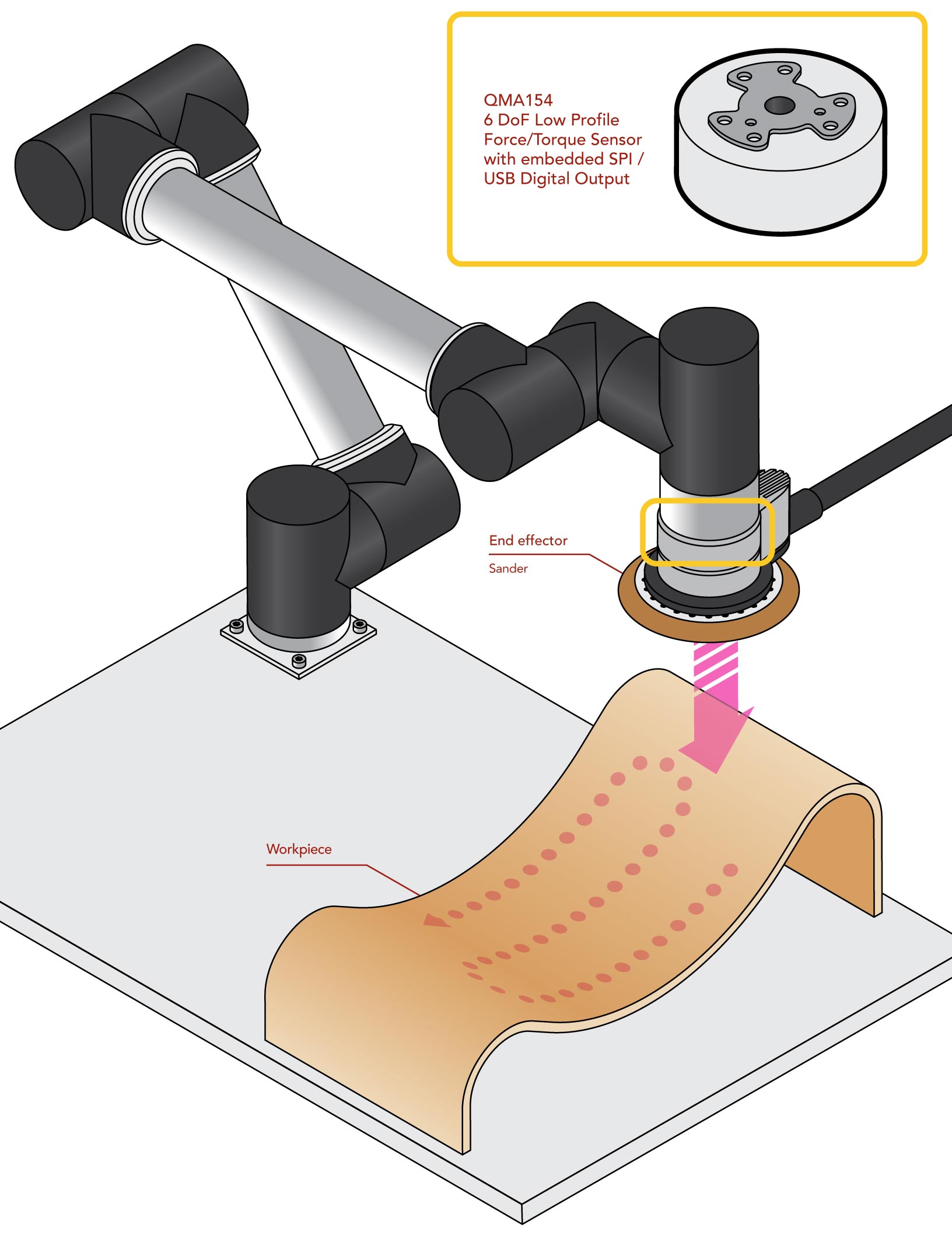
Sanding and polishing are essential finishing steps that improve surface quality, remove imperfections, and ensure part uniformity. Traditionally performed by hand, these processes are physically demanding and prone to variability, often resulting in uneven finishes, inconsistent quality, and extended cycle times. As manufacturers adopt more advanced robotic automation, these finishing operations are becoming an important example of how Physical AI and embodied robotics rely on real-world interaction data to perform contact-rich tasks with greater consistency.
Collaborative robots (cobots) and other robotic solutions address these challenges by automating repetitive, high-precision surface finishing work. Programmed to follow controlled motion paths, robotic arms can deliver repeatable results, reduce operator fatigue, and improve throughput. However, in sanding and polishing applications, motion alone is not enough. The robot must also understand how much force is being applied at the point of contact, how the abrasive tool interacts with the surface, and how those forces change across complex part geometries.
This is where force and torque feedback become critical. In Physical AI and embodied automation systems, reliable sensor data helps bridge the gap between programmed motion and real-world material interaction. By integrating a 6 DoF force/torque sensor into the robotic sanding or polishing system, engineers can capture multi-axis force and moment data that supports more consistent pressure control, improved process repeatability, and better adaptation to changing surface conditions.
Key features and benefits of FUTEK's digital QMA154 sensor:
- 6-axis force and torque measurement: Measures up to 500 N in Fx/Fy, 1000 N in Fz, and 35 Nm in Mx/My/Mz enabling precise multi-directional control. This allows robotic arms to maintain ideal contact pressure, adjust to surface irregularities, and ensure consistent material removal.
- Digital SPI/USB-C output: Enables direct communication with modern robotic controllers—eliminating the need for signal converters. This simplifies system integration and supports tighter, more responsive force/torque control loops.
- Achieve up to 4800 samples per second: Supports high-speed feedback loops for real-time corrective action of applied forces and torques. This allows quick response to surface defects and improves process repeatability through proper tool positioning during operation.
- Compact and lightweight design: With a footprint of just 62 mm in diameter and under 400 grams, the QMA154 integrates seamlessly into most robot end-of-arm tooling (EOAT) assemblies. Its minimal mass also helps preserve arm dexterity which is critical for increasing cycle efficiency.
- Safe overload protection: Capable of withstanding up to 2000 N in Fx/Fy, 4000 N in Fz, and 100 Nm of torque in order to safeguard against unexpected or accidental collision events.
- Built-in LED fault detection: Monitors for temperature compliance and open or short circuit failures. This allows operators to diagnose issues quickly and reduce downtime during high-throughput sanding and polishing.
- Superior measurement accuracy of 0.25% Rated Output (R.O.): Enables detection of subtle force/torque variations. This high accuracy allows precise characterization of small changes in force distribution across the abrasive surface. As a result, the robot can fine-tune its applied pressure to maintain uniform tool wear, therefore extending abrasive lifetime.
Custom-Engineered 6 DoF Sensors for Specialized Robotic Applications
FUTEK’s QMA154 sensor can be modified or fully re-engineered to address integration challenges such as non-standard mounting geometries, specific communication protocols, or high-performance environments that demand enhanced durability, temperature stability, or overload protection.
Every custom solution is engineered with a strong emphasis on risk mitigation, cost reduction, and meeting critical project timelines, ensuring your project stays on track without compromising performance. Whether you need a minor adaptation or a full engineer-to-order solution, FUTEK provides the custom sensing hardware that robotic arm manufacturers and tooling developers trust when precision, durability, and system integration matter most.
Contact Us
Please Contact Us with questions.
Bringing Precision and Consistency to Surface Finishing with Robots
Sanding and polishing are essential finishing steps that improve surface quality, remove imperfections, and ensure part uniformity. Traditionally performed by hand, these processes are physically demanding and prone to variability, often resulting in uneven finishes, inconsistent quality, and extended cycle times. As manufacturers adopt more advanced robotic automation, these finishing operations are becoming an important example of how Physical AI and embodied robotics rely on real-world interaction data to perform contact-rich tasks with greater consistency.
Collaborative robots (cobots) and other robotic solutions address these challenges by automating repetitive, high-precision surface finishing work. Programmed to follow controlled motion paths, robotic arms can deliver repeatable results, reduce operator fatigue, and improve throughput. However, in sanding and polishing applications, motion alone is not enough. The robot must also understand how much force is being applied at the point of contact, how the abrasive tool interacts with the surface, and how those forces change across complex part geometries.
This is where force and torque feedback become critical. In Physical AI and embodied automation systems, reliable sensor data helps bridge the gap between programmed motion and real-world material interaction. By integrating a 6 DoF force/torque sensor into the robotic sanding or polishing system, engineers can capture multi-axis force and moment data that supports more consistent pressure control, improved process repeatability, and better adaptation to changing surface conditions.
Key features and benefits of FUTEK's digital QMA154 sensor:
- 6-axis force and torque measurement: Measures up to 500 N in Fx/Fy, 1000 N in Fz, and 35 Nm in Mx/My/Mz enabling precise multi-directional control. This allows robotic arms to maintain ideal contact pressure, adjust to surface irregularities, and ensure consistent material removal.
- Digital SPI/USB-C output: Enables direct communication with modern robotic controllers—eliminating the need for signal converters. This simplifies system integration and supports tighter, more responsive force/torque control loops.
- Achieve up to 4800 samples per second: Supports high-speed feedback loops for real-time corrective action of applied forces and torques. This allows quick response to surface defects and improves process repeatability through proper tool positioning during operation.
- Compact and lightweight design: With a footprint of just 62 mm in diameter and under 400 grams, the QMA154 integrates seamlessly into most robot end-of-arm tooling (EOAT) assemblies. Its minimal mass also helps preserve arm dexterity which is critical for increasing cycle efficiency.
- Safe overload protection: Capable of withstanding up to 2000 N in Fx/Fy, 4000 N in Fz, and 100 Nm of torque in order to safeguard against unexpected or accidental collision events.
- Built-in LED fault detection: Monitors for temperature compliance and open or short circuit failures. This allows operators to diagnose issues quickly and reduce downtime during high-throughput sanding and polishing.
- Superior measurement accuracy of 0.25% Rated Output (R.O.): Enables detection of subtle force/torque variations. This high accuracy allows precise characterization of small changes in force distribution across the abrasive surface. As a result, the robot can fine-tune its applied pressure to maintain uniform tool wear, therefore extending abrasive lifetime.
Custom-Engineered 6 DoF Sensors for Specialized Robotic Applications
FUTEK’s QMA154 sensor can be modified or fully re-engineered to address integration challenges such as non-standard mounting geometries, specific communication protocols, or high-performance environments that demand enhanced durability, temperature stability, or overload protection.
Every custom solution is engineered with a strong emphasis on risk mitigation, cost reduction, and meeting critical project timelines, ensuring your project stays on track without compromising performance. Whether you need a minor adaptation or a full engineer-to-order solution, FUTEK provides the custom sensing hardware that robotic arm manufacturers and tooling developers trust when precision, durability, and system integration matter most.