What is the Hyperloop
The hyperloop, referred to as the fifth mode of transportation, aims to move passengers at speeds comparable to commercial airplanes, while retaining the convenience of a ground transportation system. The concept envisions passenger pods propelled via magnetic levitation (maglev) technology through sealed, low-pressure tubes to significantly reduce air drag. Both the pod levitation and the reduced tube air pressure are critical to the hyperloop’s ability to travel upwards of 700 mph. Achieving such high speeds requires precise control and continuous monitoring of critical subsystems such as load distribution within the maglev suspension and torque output in the vacuum pumps. Accurate, reliable force and torque data are essential for assessing overall system health, stability, and reliability.
Load Measurement in Maglev Suspension Systems
Stability is paramount in high speed transportation systems. Hyperloop passenger pods must maintain a precise air gap of approximately 15mm from the track to minimize friction and ensure a smooth, safe ride. Furthermore, a pod must stay balanced, as uneven distribution of loads can cause vibrations, tilting, and other safety concerns.
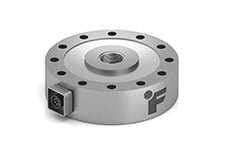
FUTEK’s LCF500 load cell can be integrated into the maglev suspension system to monitor pod weight distribution and center of gravity. Its stainless-steel construction provides exceptional strength and supports loads up to 50,000 lbs. with an accuracy of 0.1% of Rated Output (RO). Despite its rugged design, the LCF500 maintains a compact form factor of less than 6” in diameter and 1.75” in height. Additionally, the load cell can be equipped with a tension base to maximize repeatability when used in tension.
Vacuum Pump Monitoring Through Torque Sensing
To sustain high operating speeds, hyperloop systems rely on maintaining very low tube pressures (approximately 1/1000th atmospheric pressure) using an array of vacuum pumps. These pumps help in reducing air resistance, enabling the pods to glide at high velocities with minimal drag. Continuous monitoring of the pump performance is essential for detection of mechanical wear or vacuum leaks.
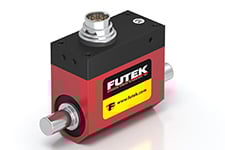
FUTEK’s TRS605 shaft-to-shaft rotary torque sensor provides real-time torque data for vacuum pump systems. Employing non-contact measurement technology, the TRS605 ensures long-term reliability with minimal mechanical wear, even in demanding high-torque applications up to 1000 Nm. An integrated quadrature encoder tracks shaft angles and speeds up to 7,000 RPM, enabling motor power calculations, an essential parameter for assessing pump health. The sensor’s amplified +/-5 VDC output allows for seamless integration with existing PLCs, DAQs, and hyperloop control systems.
Beyond weight distribution and vacuum pump monitoring, FUTEK’s sensors can support additional hyperloop subsystems critical to safety and reliability. Load cells installed at tube support pylons and expansion interfaces can monitor loads caused by thermal expansion and dynamic pod passage. In emergency braking systems, load cells and torque sensors can be used to ensure controlled deceleration remains within passenger safety limits. Torque sensing can also be applied to pod door, hatch, and airlock actuation mechanisms to confirm proper operation.
How it Works
Multiple LCF Series load cells may be placed along the hyperloop pod to measure weight distribution. The low-level mV signal from the load cells is converted to either a VDC or mA signal with FUTEK’s IAA Series of analog amplifiers.
-
The analog signal is then processed by a control system, which dynamically adjusts the electromagnets within the maglev suspension system, to maintain proper air gap, stability, and alignment.
Within the vacuum pump array, TRS605 torque sensors are installed in-line with rotating shafts to monitor torque. The embedded quadrature encoder with TTL-level output provides additional characterization of system performance through measurement of shaft position and speed.
The amplified +/- 5 VDC output interfaces directly with a PLC or DAQ for both closed-loop control and monitoring applications.
Contact Us
Please Contact Us with questions.
What is the Hyperloop
The hyperloop, referred to as the fifth mode of transportation, aims to move passengers at speeds comparable to commercial airplanes, while retaining the convenience of a ground transportation system. The concept envisions passenger pods propelled via magnetic levitation (maglev) technology through sealed, low-pressure tubes to significantly reduce air drag. Both the pod levitation and the reduced tube air pressure are critical to the hyperloop’s ability to travel upwards of 700 mph. Achieving such high speeds requires precise control and continuous monitoring of critical subsystems such as load distribution within the maglev suspension and torque output in the vacuum pumps. Accurate, reliable force and torque data are essential for assessing overall system health, stability, and reliability.
Load Measurement in Maglev Suspension Systems
Stability is paramount in high speed transportation systems. Hyperloop passenger pods must maintain a precise air gap of approximately 15mm from the track to minimize friction and ensure a smooth, safe ride. Furthermore, a pod must stay balanced, as uneven distribution of loads can cause vibrations, tilting, and other safety concerns.
FUTEK’s LCF500 load cell can be integrated into the maglev suspension system to monitor pod weight distribution and center of gravity. Its stainless-steel construction provides exceptional strength and supports loads up to 50,000 lbs. with an accuracy of 0.1% of Rated Output (RO). Despite its rugged design, the LCF500 maintains a compact form factor of less than 6” in diameter and 1.75” in height. Additionally, the load cell can be equipped with a tension base to maximize repeatability when used in tension.
Vacuum Pump Monitoring Through Torque Sensing
To sustain high operating speeds, hyperloop systems rely on maintaining very low tube pressures (approximately 1/1000th atmospheric pressure) using an array of vacuum pumps. These pumps help in reducing air resistance, enabling the pods to glide at high velocities with minimal drag. Continuous monitoring of the pump performance is essential for detection of mechanical wear or vacuum leaks.
FUTEK’s TRS605 shaft-to-shaft rotary torque sensor provides real-time torque data for vacuum pump systems. Employing non-contact measurement technology, the TRS605 ensures long-term reliability with minimal mechanical wear, even in demanding high-torque applications up to 1000 Nm. An integrated quadrature encoder tracks shaft angles and speeds up to 7,000 RPM, enabling motor power calculations, an essential parameter for assessing pump health. The sensor’s amplified +/-5 VDC output allows for seamless integration with existing PLCs, DAQs, and hyperloop control systems.
Beyond weight distribution and vacuum pump monitoring, FUTEK’s sensors can support additional hyperloop subsystems critical to safety and reliability. Load cells installed at tube support pylons and expansion interfaces can monitor loads caused by thermal expansion and dynamic pod passage. In emergency braking systems, load cells and torque sensors can be used to ensure controlled deceleration remains within passenger safety limits. Torque sensing can also be applied to pod door, hatch, and airlock actuation mechanisms to confirm proper operation.
